What is tissue Optics?
Tissue Optics describes the interaction of light, treated either as photons or waves, with biological tissue. In particular, the transport of light is studied in bulk tissues like brain, muscle or skin or teeth. The aim is the mathematical description of measurement parameters like intensity, time-of-flight, polarization or coherence.
What can be measured?
The objective is to measure absorbers (chromophores) and their concentrations scattering properties. blood flow, and tissue structure.
In biological tissue the absorption is dominated by a few chromophores, i.e.:
- water,
- haemoglobin and myoglobin (in muscle),
- lipids,
- aminoacids,
- melanin.
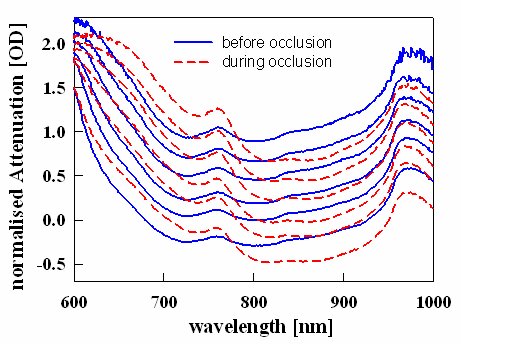
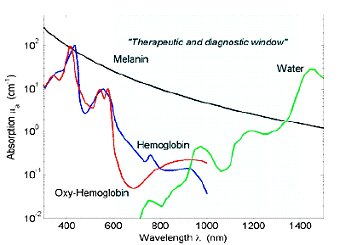
When looking at the absorption spectra over the Vis - NIR range (see figure) it is apparent that the absorption is low for wavelengths from 600 - 900 nm. Therefore, in this range the penetration into tissue is large (optical window).
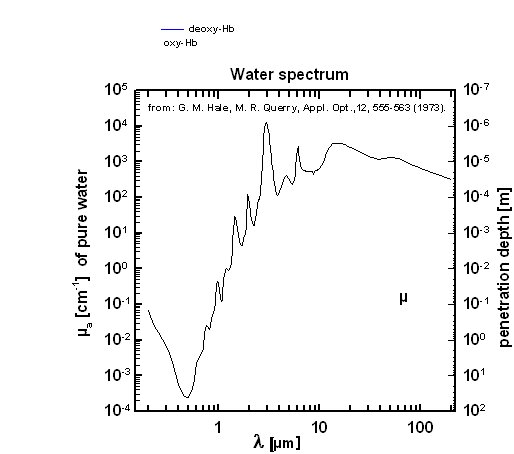
When looking at the water absorption spectrum over a larger wavelength range this optical window is even more apparent. The penetration depth, i.e. in inverse of the absorption coefficient, is smaller than 1 mm for all wavelength larger than about 1 µm.